
Ancient Ephesus
Ancient Ephesus
Ephesus is easiest to understand as a connected city rather than a collection of photogenic ruins. The upper civic quarter, sloping processional street, wealthy houses, commercial square, theatre and harbour approach each performed a different task. Their positions still reveal how public ceremony, trade, water and movement were organised.
22 guides to the excavated city

Begin with the city
Three guides that set the scale and character of the excavated city.
Memory and display
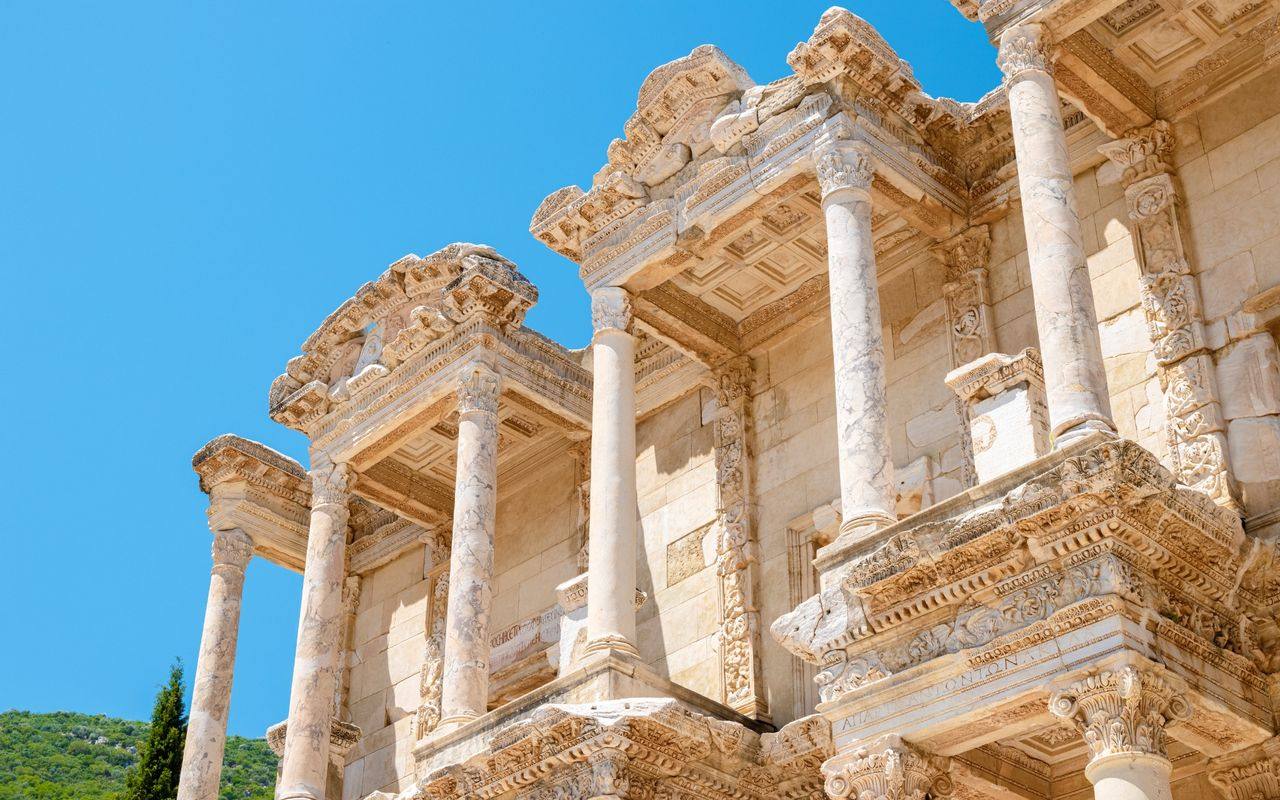
Library of Celsus
Read the Library of Celsus accurately: a second-century library and memorial tomb whose famous façade was re-erected in the 1970s.

Movement
Curetes Street
Walk Curetes Street as an ancient processional route transformed into a Roman urban boulevard and later a restricted pedestrian street.

Private life
Ephesus Terrace Houses
Look inside Terrace House 2 at Ephesus: seven elite Roman homes with wall paintings, mosaics, marble finishes, repairs and ancient graffiti.


Public life and performance
Where the city assembled, traded and maintained itself.
Spectacle
Great Theatre of Ephesus
See how the Great Theatre grew from a Hellenistic building into one of Roman Asia’s largest performance and assembly spaces.
Trade
Commercial Agora of Ephesus
Understand the Tetragonos Agora beside the Library of Celsus as the organised commercial centre of a Roman harbour city.
Council and performance
Odeon of Ephesus
Read the small auditorium beside the Upper Agora as a civic council building and performance space, while keeping uncertain reconstructions labelled.
Urban infrastructure
Public Latrines of Ephesus
Inspect the communal stone seating and water channels at the Ephesus latrines without repeating unsupported tourist folklore.
Monuments along the route
Facades and fountains encountered while walking the main street.
Dedication
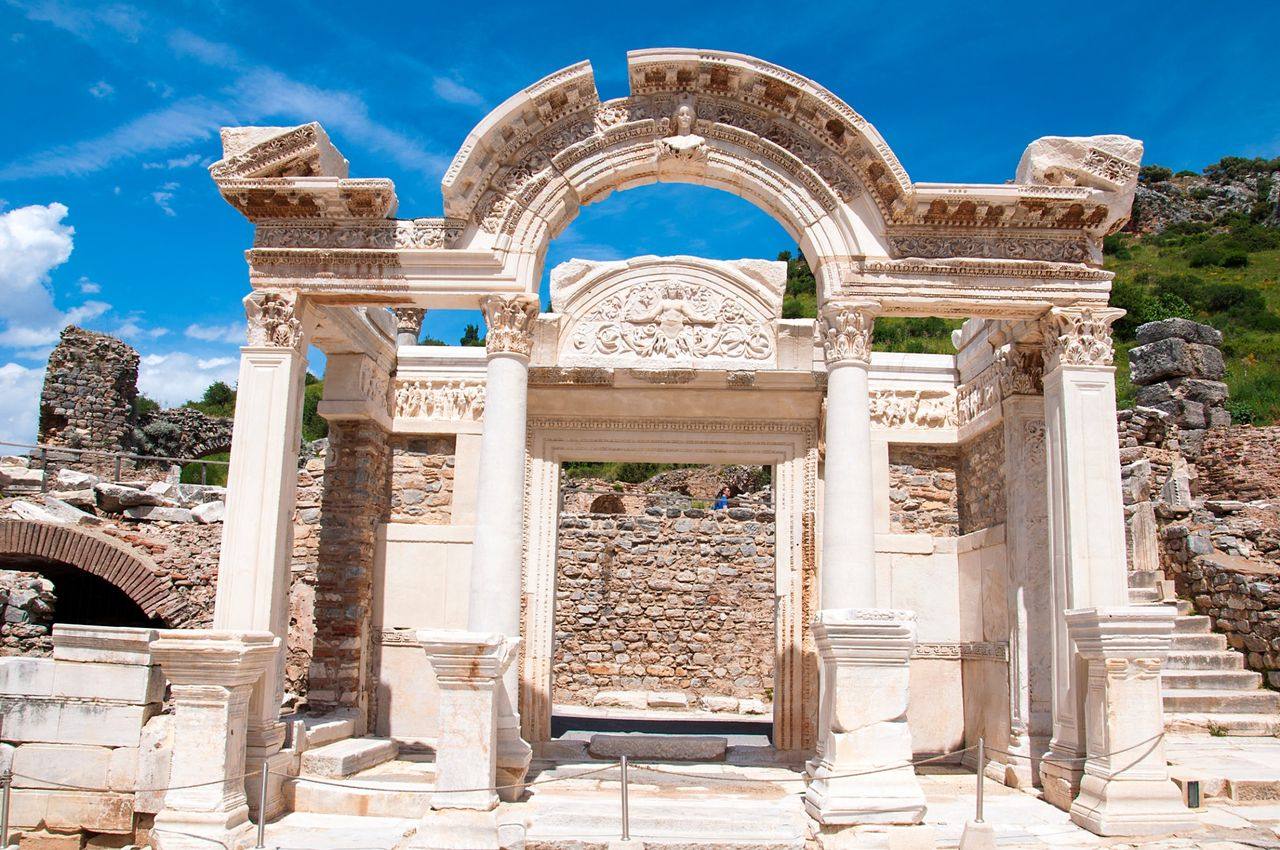
Temple of Hadrian
Examine the so-called Temple of Hadrian on Curetes Street, its private dedication, re-erected façade and place in the Artemis processional route.
Water and display
Fountain of Trajan
See the Nymphaeum Traiani as both water infrastructure and civic display on Curetes Street.
Restricted movement
Hercules Gate
Notice how the relief-bearing gate narrowed Curetes Street and changed movement through late antique Ephesus.

Upper city and approaches
The upper terraces, a bath complex and the southeastern approach.
Imperial space
Domitian Square and Temple
Examine the imperial-cult terrace at the Upper Agora and why scholars qualify the familiar name “Temple of Domitian.”
Bathing
Bath of Varius at Ephesus
Explore the Bath of Varius beside Curetes Street: its Hadrianic stair, named benefactors, later brick rebuilding and Scholastikia inscription.
Inscription and second name
Baths of Scholastica
A headless seated statue and one inscribed base gave the Bath of Varius a second name. Read what Scholastikia's text says — and what it does not.
Approach
Magnesian Gate of Ephesus
Place the Magnesian Gate in the city’s southeastern circuit and understand its role in linking Ephesus to inland roads.
Streets and civic squares
The paved routes and official spaces that structured the city.
Paving and reuse
Marble Street
Walk Marble Street between the agora corner and the Great Theatre, and read its slabs as evidence of repair, reuse and changing public display.
Route west
Harbour Street (Arcadian Way)
Stand at the Great Theatre and follow Harbour Street west toward a harbour that is no longer there: colonnades, phases and a late-antique monument.
Civic square
State Agora
Read the upper square at Ephesus through its edges: council house, Prytaneion and stoa explain why archaeologists call it the State Agora.
Civic ritual
Prytaneion of Ephesus
The city kept an eternal fire here for Hestia Boulaia, fed official guests and recorded its Curetes. Read the Prytaneion from its final publication.
Harbour, gates and memorials
The harbour landscape and the monuments that commemorated families and emperors.
Harbour
Ancient Port of Ephesus
Cores, geophysics and survey have mapped the harbour of Ephesus. Learn how a shifting coastline reshaped the city instead of ending it overnight.
Dedication gate
Gate of Mazeus and Mithridates
The three-passage South Gate beside the Library of Celsus carries a dedication to Augustus and Livia, dated by its titulature to 4/3 BCE.
Family memorial
Memmius Monument
The inscription names C. Memmius as a grandson of Sulla Felix. See how family lineage, architecture and modern reconstruction meet on Curetes Street.
Water display
Pollio Fountain
One tall arch, three different labels. Untangle the apsidal fountain on Domitian Square from the Pollio monument and the Pollio aqueduct.
Official sources
Current visitor information — opening hours, tickets and closures — is published by the site authorities, not by us.
- Austrian Archaeological Institute — the history of Ephesos (opens in a new tab)
Archaeological overview from the institute that excavates at Ephesus.
- Forschungen in Ephesos — open-access publication series (opens in a new tab)
The excavation's own published research volumes.
- UNESCO World Heritage Centre — Ephesus (opens in a new tab)
The official World Heritage record for the Ephesus property.
Continue exploring the Ephesus guide
Plan Your Visit
Practical orientation, official visitor information and preparation.
History & Life
Settlement, empire and the evidence for everyday life.
Faith & Mythology
Artemis, early Christian Ephesus and later sacred tradition, kept distinct.
Around Ephesus
Selçuk, Şirince and the wider region of western Anatolia.